Why many pet owners avoid flying pets in cargo.
Air travel can be the right choice for some pets, especially when a small dog or cat qualifies for the passenger cabin. But when the only airline option is checked or cargo transport, the decision becomes more complicated. Here is what current airline, DOT, USDA and IATA guidance says—and when door-to-door ground transport may be worth considering instead.
Policy sources reviewed September 11, 2026
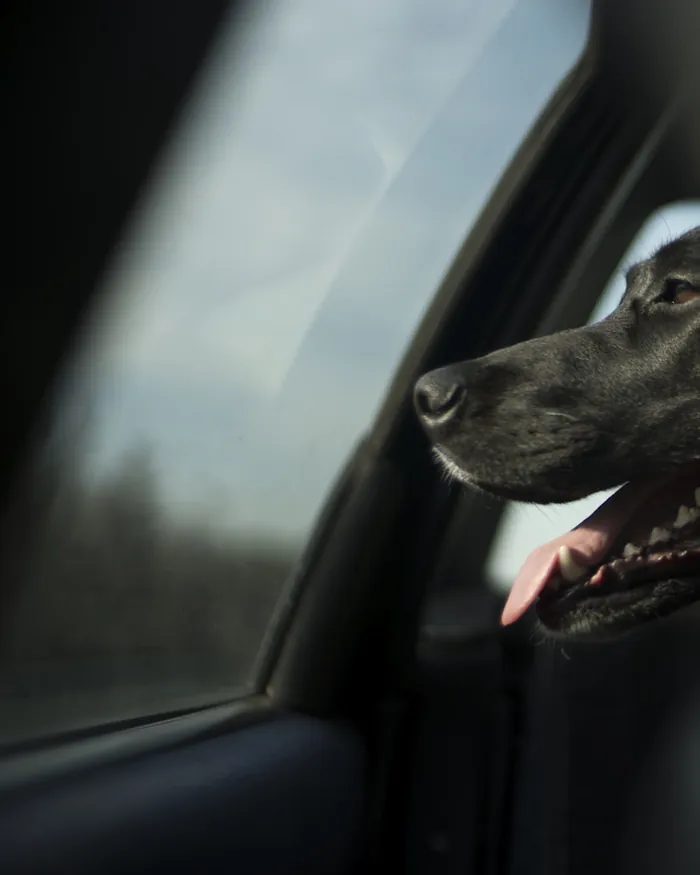
Illustrative stock photo: Cup of Couple / Pexels.
Cabin, checked pet and manifest cargo are not the same thing.
When people say a pet is “flying cargo,” they can mean different airline products. A small pet may travel in the passenger cabin inside an approved carrier under the seat. Some airlines allow certain animals as checked pets on eligible aircraft. Others move animals through a cargo program, where the animal is booked and handled as a live-animal shipment.
Those differences matter. In-cabin travel keeps the pet physically close to its owner. Checked and cargo programs add airline handling procedures, acceptance windows, kennel requirements, weather restrictions, transfer points and periods when the owner cannot access the animal.
The biggest concerns happen around handling, weather and access—not just the flight itself.
Airlines that accept live animals publish detailed procedures because temperature, ground time, routing and animal condition matter. Delta Cargo, for example, currently requires forecast temperatures to remain between 20°F and 80°F while temperature-restricted animals are in Delta's care on the ground, including at origin, transfer and destination. When the forecast is between 20°F and 45°F, an acclimation statement may be required. [Delta Cargo]
Breed restrictions can be even more important. American Airlines currently does not accept brachycephalic or snub-nosed dogs and cats as checked pets. That includes breeds such as Bulldogs, Pugs, Boxers, Persians and Himalayans, along with listed mixes. [American Airlines]
This does not mean every cargo trip is dangerous. It means the pet's breed, health, route, season, connections and airline program need to be evaluated rather than treating cargo as a routine baggage choice.
animal incidents were reported by covered airlines in 2024—10 deaths, 3 injuries and no losses—among 161,335 animals transported, according to the U.S. Department of Transportation. That equals 0.81 reported incidents per 10,000 animals transported. [U.S. DOT]
The raw rate is low, but statistics alone cannot tell you whether cargo is a good fit for a particular senior pet, flat-faced breed, anxious animal or complicated multi-stop itinerary.
Keeping a small pet in the cabin is usually the first airline option to investigate.
Airline rules vary by aircraft and route, so do not rely on a general weight rule you saw online. American Airlines, for example, currently requires carry-on pets to fit comfortably inside a closed carrier that fits under the seat. Its recommended soft-sided carrier maximum is 18 × 11 × 11 inches. The often-repeated 20-pound pet-plus-carrier limit is not a universal American Airlines rule; it applies to the premium cabin on the three-cabin A321T. [American Airlines]
IATA recommends contacting the airline in advance to confirm that the pet is accepted on the specific flight and reconfirming at least 48 hours before departure. That matters because airlines can limit the number of pets in the cabin and aircraft-specific storage can change what is permitted. [IATA]


There is no single domestic “10-day rule” that applies to every pet on every trip.
USDA APHIS states that interstate entry requirements for pets are set by the receiving State or Territory. Depending on the destination, those rules may include a health certificate, vaccinations, tests or treatments. Airlines can add their own requirements on top of the destination rules. [USDA APHIS]
For example, Delta Cargo currently requires a domestic health certificate signed by a USDA-accredited veterinarian within 10 days of travel for its pet cargo program. That is an airline cargo requirement—not a universal rule for every pet traveling within the United States. [Delta Cargo]
International travel can require substantially more planning. Depending on the destination, requirements may include a microchip, rabies vaccination, laboratory testing, import permits, an international health certificate and USDA APHIS endorsement. [USDA APHIS] Dogs entering the United States are also subject to current CDC dog-import requirements, including a CDC Dog Import Form receipt. [CDC]
Ground transport can remove the airline cargo decision entirely.
If a pet is too large for normal in-cabin travel, is excluded from checked transport because of breed or aircraft restrictions, has significant travel anxiety, or simply is not a good fit for a cargo itinerary, long-distance ground transport is another option for routes that can be completed by road.
Snout Route provides door-to-door ground pet transport across the contiguous United States, Alaska by road through Canada, and Canada. The service is ground-only; Snout Route does not ship pets by airline cargo.
Compare the actual trip, not just the phrase “pet transport.”
For a deeper provider checklist, see How to Choose a Pet Transport Company. If anxiety is the main concern, use our guide to transport for anxious dogs.
Do not let “cargo” become the default just because your pet cannot fit under a seat.
Start by asking whether your pet qualifies for the passenger cabin on the exact aircraft you plan to fly. If not, review the airline's current checked or cargo rules, temperature restrictions, breed exclusions and documentation requirements before deciding that air travel is the right fit.
For pets that do not fit comfortably into that system, ground transport can be a practical alternative on U.S. and Canada routes. It replaces airport handling with a road itinerary and gives owners a different set of tradeoffs to evaluate.
Current policies used for this guide.
- U.S. Department of Transportation — 2024 animal incident statistics
- American Airlines — current pet travel policy, carrier dimensions and breed restrictions
- Delta Cargo — pet temperature and health-certificate requirements
- USDA APHIS — interstate pet travel requirements
- USDA APHIS — international pet travel process
- CDC — Dog Import Form and U.S. dog-entry instructions
- IATA — Traveler's Pet Corner
Policies can change. Always verify the airline, destination and veterinary requirements again before booking.